








AI & Emerging Tech
“If you haven’t built an agent, you’re missing out”: Holger Mueller on the new rules of enterprise AI at TechHR Singapore 2026






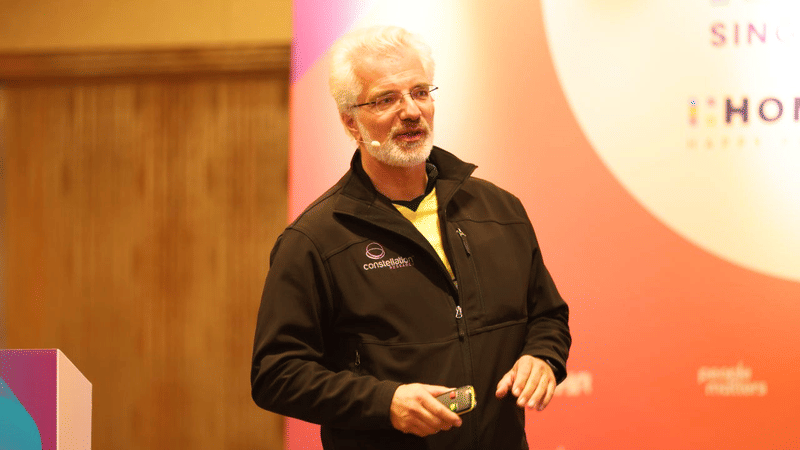
At TechHR Singapore 2026, Holger Mueller outlines a new AI economy where tokens become the currency of work, enabling enterprises to allocate AI budgets and redefine how productivity is measured.
At a time when artificial intelligence is no longer a futuristic promise but a present-day imperative, Holger Mueller, Vice President and Principal Analyst at Constellation Research, delivered a compelling closing keynote at People Matters TechHR Singapore 2026.
Mueller’s keynote titled, “How To Make AI Your Enterprise’s Competitive Edge,” cut through the noise to offer a pragmatic roadmap for organisations navigating the AI era.
Making his message clear that the enterprises that will win are not those experimenting with AI, but those operationalising it at speed and scale.
A New Pace of Change
"We typically talk about what's going to happen for your enterprise in the next five years," Mueller noted. "In our framework, five years is too long. Things are moving so fast."
Instead, he urged leaders to rethink planning horizons and focus on four interconnected forces: shifting workforce dynamics, rapid technological acceleration, evolving business goals, and real-time market changes. At the core of all of this, he emphasized, lies one unavoidable reality, enterprise acceleration.
"Enterprises have to move faster, become better competition, to survive and stay in competition," he said.
The Machine Era, Reimagined
Drawing on historical parallels—from domesticated animals to steam engines and electrification, Mueller positioned AI as the next transformative leap. But unlike previous revolutions, AI is not just about automation, it is about decision-making.
"AI, for the first time, is this intermediate between decision making and execution," he explained. "That is the breakthrough."
This shift is also happening at unprecedented speed. "The adoption curve… is much, much faster," Mueller observed, warning that enterprise cycles must compress accordingly.
From Interfaces to Intent
One of AI’s most profound changes, Mueller argued, is the shift in how humans interact with technology.
"It allows conversation as a UX, you don’t have to use a keyboard," he said. "It understands what you're saying, understands the intent."
This evolution, from commands to conversations, unlocks massive automation behind the scenes, enabling enterprises to operate at what he described as "machine-level speed."
The Rise of Autonomous Work
The implications for work are already visible. Software development, once a highly manual process, is rapidly transforming.
"Coding is now autonomous," Mueller said. "The paradigm is shifting from one person and one software agent to one person who has written multiple software agents."
This shift is not limited to developers. Mueller highlighted the rise of citizen developers, where business users, including HR professionals, can build AI agents themselves.
"It has to be built by a practitioner," he emphasized. "You and your HR colleagues can build agents."
The Real Bottleneck: Technical Debt
Despite the promise, many organisations are struggling to move forward—not because of lack of ambition, but because of legacy constraints.
"The biggest problem holding you back… is technical debt," Mueller said, referring to outdated systems and past technology decisions that limit current capabilities.
Without addressing this, enterprises risk being unable to even access foundational AI infrastructure. "You cannot run AI very effectively… if you are in crisis, you cannot even buy the GPUs," he warned.
Data Is Still the Differentiator
If there is one constant in the AI conversation, it is data, and Mueller reinforced its centrality. "What makes the quality of AI? … It’s the data," he said.
However, the challenge is not just having data, but unifying it. He advocated for the adoption of data lakehouse architectures that bring together structured and unstructured data across the enterprise.
"If you don’t bring the data together, you will be subpar," he cautioned.
Crucially, this means breaking silos between systems, from HR and CRM to ERP and manufacturing, so that AI can generate meaningful, enterprise-wide insights.
Owning Your Automation
A recurring theme in Mueller’s keynote was ownership. Enterprises must not outsource their AI future entirely to vendors. "It allows you to own your automation," he said.
While vendors will provide foundational tools and pre-built agents, organisations must build their own capabilities to remain competitive. "There is no right or wrong answer… but you will end up buying what you can and building what you must," he explained.
Governance: Build First, Then Control
On the often-debated topic of AI governance, Mueller offered a refreshingly practical perspective.
"First you have to build it," he said. "If you govern something which you haven’t built, there’s nothing to govern."
Rather than letting governance slow down innovation, he encouraged organisations to start small, learn quickly, and then layer in safety, repeatability, and security.
The Road Ahead: Agents, Everywhere
Looking forward, Mueller outlined a clear trajectory for enterprise AI adoption:
2025: Focus on building the data foundation through data lakehouses
2026: Invest in agent frameworks and begin scaling AI agents
2027 and beyond: Prepare for multi-agent ecosystems where AI systems interact with each other autonomously
"You will have 20, 30, 40, 50 agents… it’s your software, your agency, your enterprise," he said.
This shift will also redefine workforce structures. While AI will augment roles in the short term, certain functions, especially document-heavy jobs—will see significant disruption.
"You’ll see augmentation… but you’ll also see replacement," he noted.
The Cost of AI, and the New Currency of Work
Mueller also introduced an emerging concept: AI as a resource with measurable cost and allocation.
"Think about tokens as a new way of understanding what a person is doing in your enterprise," he said, pointing to a future where employees are assigned AI budgets similar to salaries or tools.
The Bottom Line: Speed Wins
In closing, Mueller distilled the competitive equation into a simple but powerful insight - "Your company moves only as fast as your platform," he said. "You can only get ahead if your company moves faster than your market."
For leaders, the message was unmistakable. AI is no longer a side initiative, it is the operating system of the modern enterprise. And the time to act is now.
"Start," Mueller urged. "If you have not built an agent… you’re missing out."
As the session concluded, it made it clear in the race to AI maturity, hesitation is the biggest risk, and execution is the only differentiator.
Author
Loading...
Loading...