








AI & Emerging Tech
TechHR Singapore 2026: Conscious acceleration and human values take centre stage in Koo Sengmeng’s address





What truly set Sengmeng’s address apart was his insistence on the human dimension of technological change. “AI transformation is not just about technology. It’s about people,” he declared.
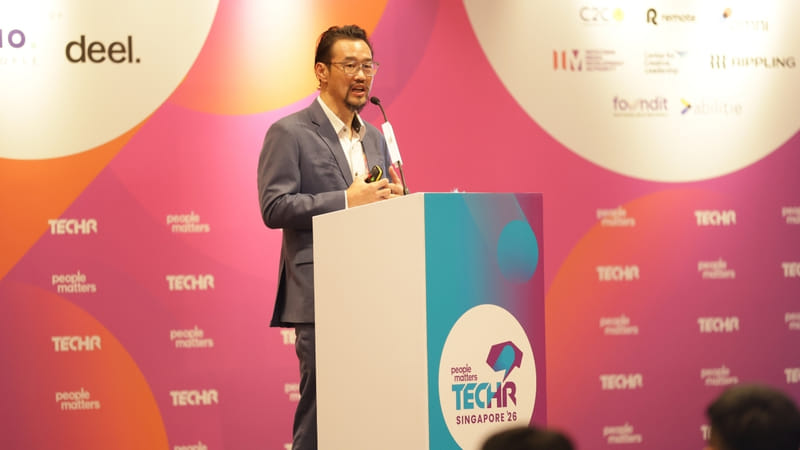
In an era defined by relentless technological disruption, Koo Sengmeng, Director of Talent & Ecosystem at AI Singapore, delivered a stirring address at People Matters TechHR Singapore 2026, urging leaders to embrace “conscious acceleration” and lead with purpose at the speed of change. Speaking to a packed house of HR professionals, technologists, and business leaders, Sengmeng delivered a powerful call to action: to harness AI’s potential not only for efficiency and growth but also for building a legacy of responsible, human-centred progress.
The AI Journey: From pioneering to pervasive
Sengmeng began by tracing Singapore’s remarkable journey with artificial intelligence, recalling milestones that have shaped both the nation and the wider region. “Thirty years ago, computer vision was a novelty. Today, it’s everywhere, from your phone’s camera to complex business applications,” he reflected. He described how the current wave of AI, which took off in 2012, is now embedded in daily life, powering everything from digital services to a nuanced understanding of human intent. “AI is pervasive. It’s no longer about whether it will impact society—it already has.”
Yet, Sengmeng was quick to caution that technological advancement has brought new risks alongside opportunities. “With every leap forward, there are disruptions,” he noted, alluding to job displacement, the proliferation of misinformation, and the growing challenge of distinguishing between machine-generated and authentic content. “It’s not just images anymore—it’s videos, voices, and sophisticated language models that can perpetuate biases if we’re not careful.”
Regional relevance and responsible innovation
Koo highlighted a critical shift in approach: the development of regional language models that reflect Southeast Asia’s linguistic and cultural diversity. “Bias in AI is real, especially when models are built far from the communities they serve,” he explained. “By creating models in our own languages, by our own practitioners, we’re shaping technology that understands us, not just the other way around.”
He also warned of increasing concentration among global tech giants and called for greater local agency. “There’s a growing need for trusted, responsible AI; one that is governed ethically and is accessible to all, not just a privileged few.”
Singapore’s Strategic Response: From AI 1.0 to 2.0
Reflecting on AI Singapore’s evolution since 2017, Sengmeng outlined the nation’s strategic response. The initial focus was on “infusing knowledge into the ecosystem,” but the imperative soon shifted to equipping the workforce and businesses with practical AI skills. “It’s not about more AI, but about using it wisely,” he said, referencing the National AI Strategy 2.0, launched in late 2022, which centres on responsible AI, talent development, and building a globally competitive ecosystem.
He emphasised the unique challenges Singapore faces as a city-state: “We have physical limits—not just in energy but in land and water. That means we need to be clever and targeted in our AI investments.” He pointed to the concept of ‘AI bilingualism’, the development of both domain expertise and digital fluency, as the key to future-proofing Singapore’s workforce.
A Human-Centred Framework: Talent, purpose, and meaningful impact
What truly set Sengmeng’s address apart was his insistence on the human dimension of technological change. “AI transformation is not just about technology. It’s about people,” he declared. He outlined a three-tiered approach to talent development:
AI Users: Professionals who may not code but must become proficient in digital tools relevant to their fields—be it healthcare, law, or HR.
AI Practitioners: Specialists who develop, regulate, and innovate with AI, ensuring its use is safe and effective.
AI Researchers: The vanguard who push the boundaries of what AI can do, inventing breakthroughs that shape tomorrow’s possibilities.
Sengmeng’s message was clear: “No matter where you are—at the cutting edge or simply using AI in your daily work—your mindset matters most. If you don’t approach AI with a problem to solve and a willingness to learn, no course or investment will make a difference.”
Purpose Before Technology: Stories that matter
Koo shared compelling examples from Singapore’s business landscape: from dental clinics leveraging AI to analyse X-rays and improve patient care, to companies using automation to process thousands of emails daily. “The most successful AI projects start with clarity of purpose and not just ‘because everyone else is doing it’,” he stressed. “Ask yourself: what problem are you trying to solve? What capabilities do you lack now that AI can help you achieve?”
He cautioned against a technology-first mentality, urging leaders to focus on outcomes that matter for people and communities. “Don’t just think about deployment; think about employment. AI is not just about replacing tasks, but about augmenting human judgement and unlocking new opportunities.”
Building optimism amidst uncertainty
Sengmeng’s closing remarks struck a note of optimism, even as he acknowledged the anxiety that technological change can bring. “For every fear about AI taking over, there’s a corresponding hope about what it can help us achieve,” he said. “Those of you who have spent years honing your expertise, your value lies not in the tasks you perform, but in your judgement and adaptability. AI can automate many things, but it cannot replace the uniquely human ability to find meaning and purpose in what we do.”
He left the audience with practical advice: cut through the noise, experiment with AI tools, and focus on those that genuinely enhance your work. “The best AI tools are the ones you return to, unconsciously, every day. They are your allies, not your replacements.”
The call to legacy
As the applause died down, it was clear that Sengmeng’s message had resonated. In a world where AI’s pace threatens to leave many behind, his call for conscious acceleration, rooted in purpose and guided by human values, felt both urgent and uplifting. “The future isn’t something that happens to us,” he concluded. “It’s something we build, together, by leading with intent and courage at the speed of change.”
Koo’s address was more than a reflection on Singapore’s AI journey; it was a manifesto for leadership in turbulent times; a reminder that while technology may shape our tools, it is our purpose that shapes our legacy.
Loading...
Loading...