








Leadership
“Hyper-connected but deeply disconnected”: David Fish on the growing gap leaders must address



 ||
||

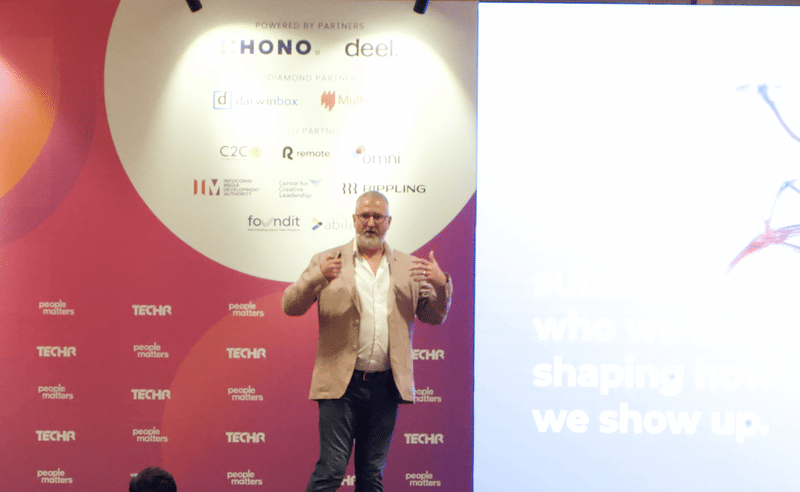
At TechHR Singapore 2026, David Fish examines how digital overload is weakening trust, presence, and real connection in leadership.
There is a moment most professionals recognise but rarely question.
You’re walking with a colleague. There is time—three minutes, perhaps—to ask how their day is going. And yet, almost instinctively, the hand reaches for the phone. An email might have come in. A notification might matter. Something, somewhere, feels more urgent than the person next to you.
David Fish began his keynote at TechHR Singapore 2026 with precisely this moment—not as anecdote, but as diagnosis.
“You know that moment when you have a choice— to talk to your colleague as you walk… And yet, that thing in your hands is calling you,” he said.
What appears trivial, he suggested, is anything but. It is, in fact, a pattern. And patterns, when repeated at scale, quietly become culture.
The connectivity paradox no one designed
The modern workplace runs on an assumption: more connectivity should lead to better collaboration, faster decisions, and stronger alignment.
But Fish challenged that logic.
“This is the most powerful personal device we’ve ever had in the history of humanity— and we use this to stop having to connect,” he said.
It is a line that lands because it feels uncomfortably accurate.
On paper, the conditions for connection have never been better. Teams span geographies. Communication is instant. Access is near-total. Yet, as Fish pointed out, the lived experience tells a different story.
“We are more digitally connected than we have ever been… but we have never felt further from ourselves— and from each other,” he said.
Trust still works. Leadership doesn’t—at least not fully
Fish drew a useful distinction that cuts through much of the noise around leadership: not all trust is created equal.
Most systems, he said, run perfectly well on what he calls functional trust. You book a taxi. A car arrives. You get in. Not because you know the driver—but because the system signals reliability.
“Does it look like they can do what they said they can do?” he said. That is enough to keep things moving. But leadership operates on a different plane.
“The world can function on functional trust. But leaders cannot lead the future without emotional trust,” he said. And this is where the gap begins to widen.
Because while systems have scaled, emotional trust has not kept pace. In fact, in many cases, it is eroding—quietly, incrementally, and often invisibly.
The unspoken question in every room
At the centre of this erosion is something far less discussed in boardrooms than strategy or performance: fear.
Fish distilled it into a single, almost disarmingly simple question the brain asks in uncertain environments: “Am I safe?” It is the question beneath hesitation. Beneath silence in meetings. Beneath resistance to change initiatives that look perfectly sound on slides but stall in execution.
“Every single plan we can imagine… we see the strategy. But our teams hold back. Why? Fear. Uncertainty,” he said.
Leaders, meanwhile, tend to respond by doubling down on control—projecting confidence, tightening narratives, smoothing out rough edges. Which, according to Fish, is precisely the wrong move. “We project strength. We edit ourselves more. But people need the opposite,” he said.
The performance economy of leadership
If the workplace feels performative, Fish would argue that it is—by design.
He described three archetypes that quietly shape behaviour in professional settings:
- The one who says what the room wants to hear
- The one who tells a polished, almost flawless story
- The one constantly scanning for approval
Individually, these behaviours are understandable. Collectively, they create distance.
“We edit ourselves… sometimes automatically,” he said.
The deeper driver is evolutionary. Humans are wired to belong. In earlier contexts, exclusion carried existential risk. Today, the threat is subtler—social judgement, digital visibility, reputational exposure—but the instinct remains intact.
The result is a workplace where people show up, but not fully. And that partial presence comes at a cost. “We never want to be in a room where we’re not aligned with what’s really happening… because that creates a barrier,” he said.
Presence is not soft. It is strategic
If there is a single idea Fish returned to, it is this: presence is not an abstract concept. It is a measurable leadership capability.
“Presence is how we show up… it is everything that someone experiences from you in that moment,” he said.
Not what is said. Not how it is packaged. But how it is felt. Crucially, presence is built on consistency. On congruence between who someone is over time and how they appear in the moment.
“Do I feel that this person is the same person I’ve experienced before?” he said.
In a landscape increasingly shaped by AI, automation, and distributed work, this consistency becomes harder to maintain—and more valuable when it is.
The uncomfortable shift: less learning, more unlearning
Perhaps the most counterintuitive part of Fish’s argument is what leadership does not need.
“The future skill is not learning something new,” he said.
Instead, the task is inward.
“You are already the advantage… we need more authentic presence,” he added.
It is a shift from accumulation to exposure. From adding capabilities to removing filters.
And that is not always comfortable.
Because it requires noticing what is usually ignored: the moments of hesitation, the sentences left unsaid, the instinct to retreat into safer, more polished versions of oneself.
“What did I not say? What did I hold back? Where did I edit myself?” he asked.
What this means for leaders now
The broader implication is difficult to ignore.
As organisations invest heavily in technology to drive efficiency and scale, the human layer—trust, connection, presence—is becoming both more fragile and more critical.
Fish’s closing observation captured the tension succinctly: “Creativity, curiosity, collaboration—none of these are possible if we show up as roles instead of humans.”
The question, then, is not whether organisations are connected. They are.
The question is whether that connection is real enough to sustain performance, trust, and growth. Or, as Fish put it: “Is that person entering the room? The real you.”
TechHR Singapore 2026 continues to bring together global leaders to examine the evolving intersection of technology, talent, and leadership.
Stay tuned for more insights and in-depth conversations from experts shaping the future of work.
Author
Loading...
Loading...