








Economy Policy
Singapore raises retirement age to 64, offers up to S$150,000 for job redesign support






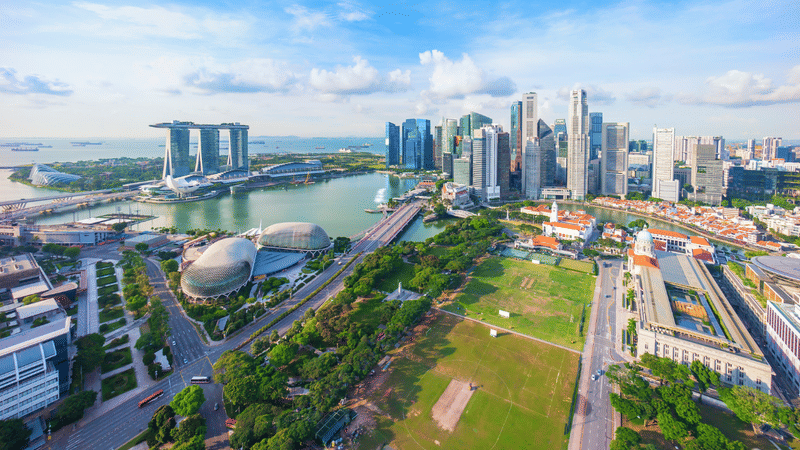
Starting July 2026, the statutory retirement age will rise to 64 and the re-employment age to 69, alongside an extension of the Senior Employment Credit scheme until December 2027.
Singapore has unveiled a wide-ranging set of labour and workforce reforms, including raising the retirement age and introducing stronger support for business transformation, as it prepares workers and companies for a rapidly changing global economy.
At the Committee of Supply Debate, the Ministry of Manpower (MOM) outlined a strategy built around empowering workers at every life stage, helping businesses adapt to technological change, and creating inclusive workplaces that ensure growth benefits all.
“Our approach rests on three pillars: empowering Singaporeans through all stages of life, enabling businesses to transform and compete, and building workplaces that work for all so that no one is left behind in Singapore’s transformation journey,” the ministry said.
Retirement age raised as workforce ages
Among the key changes is the decision to raise Singapore’s retirement age to 64 and the re-employment age to 69 from July 1, 2026.
The government also said the Senior Employment Credit (SEC) will be extended until December 2027, with the highest wage support tier of 7% for workers aged 69 and above, helping employers retain experienced older workers.
To strengthen retirement adequacy, CPF contribution rates for workers aged 55 to 65 will increase from 2027, in line with recommendations from the Tripartite Workgroup on Older Workers.
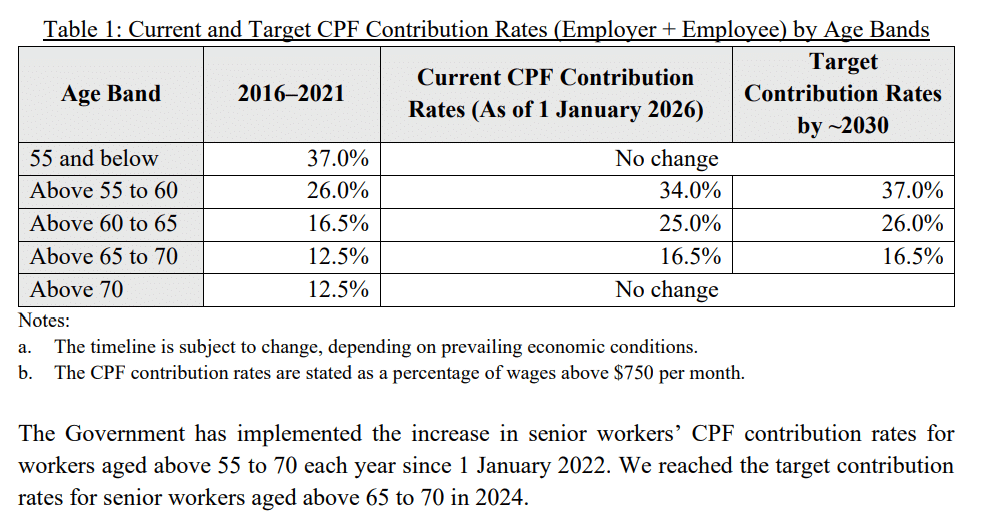
“The CPF contribution rates for senior workers aged above 55 to 60, and those aged above 60 to 65 will be increased by 1.5 and 1 percentage point respectively from 2027.
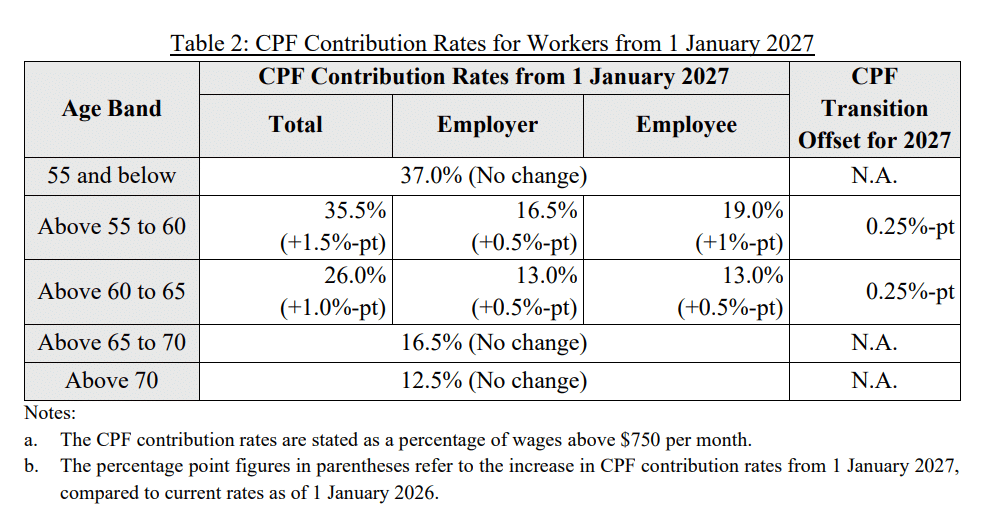
At the same time, the CPF Transition Offset will be extended by another year to December 2027, to cover 50% of the increase in employer CPF contributions in 2027,” the government said.
S$150,000 support for workforce transformation
To help companies adapt to technological change, Singapore is rolling out stronger support for workforce transformation. Under the Enterprise Workforce Transformation Package, businesses can receive funding of up to 70% of project costs for job redesign and workforce transformation initiatives, capped at S$150,000 per company.
The support, provided through the SkillsFuture Workforce Development Grant (Job Redesign+), will help firms tackle challenges such as reskilling employees and adopting technologies like artificial intelligence.
Push to build an AI-ready workforce, and merged agency to integrate skills and jobs
As announced in Budget 2026, Singapore is also ramping up efforts to prepare workers for an AI-driven future. Singaporeans who enrol in selected SkillsFuture AI courses will receive six months of free access to premium AI tools so they can experiment and apply new capabilities in their daily work.
The initiative, set to roll out in the second half of the year, is designed to help workers gain confidence working alongside AI. Also to stregthen employment support, the government is merging SkillsFuture Singapore and Workforce Singapore to create a new statutory board, Workforce and Skills Singapore.
The agency will integrate skills development and employment services, providing more seamless support in career guidance, skills advisory, training and job matching for both workers and employers.
Changes to foreign workforce policies
Singapore will also update its foreign workforce policies to maintain competitiveness while protecting local wage benchmarks.
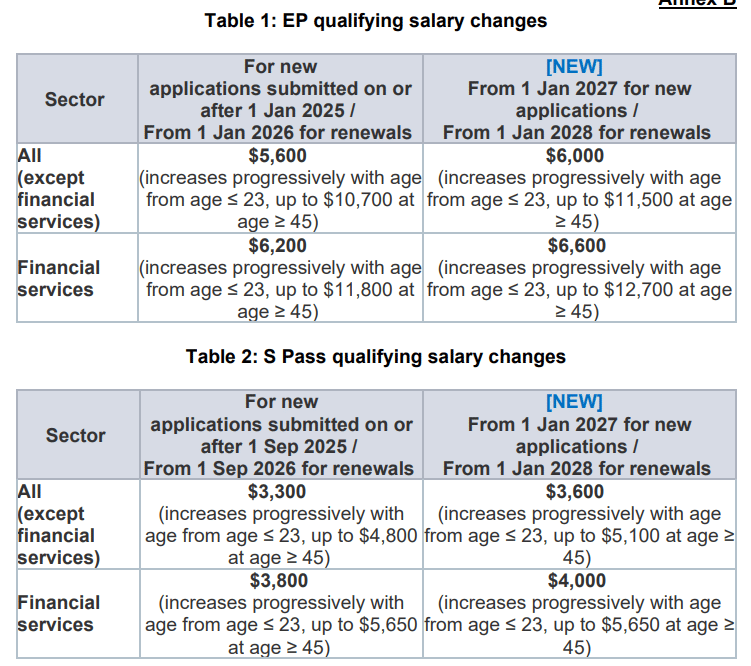
From January 2027, the minimum qualifying salary for an Employment Pass will rise from S$5,600 to S$6,000, while the S Pass threshold will increase from S$3,300 to S$3,600.
To strengthen the country’s position as a technology hub, MOM will introduce a new ONE Pass (AI and Tech) track in 2027, replacing the current Tech.Pass to attract leading global innovators and tech experts.
Higher wages and support for lower-income workers
The reforms also include measures to uplift lower-wage workers. The Local Qualifying Salary will increase from S$1,600 to S$1,800 from July 2026, while the Progressive Wage Credit Scheme will be extended until 2028 with higher government co-funding to help businesses manage wage increases.
Singapore will also work with industry partners to strengthen career pathways for skilled trades workers, including a pilot initiative with the Specialists Trade Alliance of Singapore to improve career progression in the electrical trade. “These measures reflect the Government’s commitment to building an empowered workforce and thriving workplaces for all Singaporeans,” MOM said.
The ministry added it will continue working closely with the National Trades Union Congress and the Singapore National Employers Federation to ensure workers and businesses can adapt to economic transformation. “As Singapore transforms, we will ensure that every worker and business can progress and thrive, and no one will be left behind.”
Author
Loading...
Loading...